
How to Get a Lost Attested Certificate Replaced: A Step-by-Step Guide That Actually Makes Sense

Imagine that you’re packing for a big move abroad, and the one document you need most is nowhere to be found. Sound familiar?
Losing an attested certificate feels like losing a piece of your future plans. Whether it’s your degree, your marriage certificate, or a professional license, that little stamped document carries more weight than its size suggests. Without it, visa applications stall, job offers get delayed, and university admissions hang in limbo.
But here’s the good news. A lost attested certificate isn’t the end of the road. It’s a hurdle, not a wall. This guide walks you through exactly what to do next, why attestation matters in the first place, and how to avoid this headache the next time around. Stick with us till the end, because the last section could save you weeks of back-and-forth.
Why Losing an Attested Certificate Feels Like Such a Big Deal
Ever wonder why a simple stamp on a piece of paper carries so much power? That’s the magic of attestation.
An attested certificate isn’t just a photocopy with a signature. It’s official proof, verified by government bodies, that your document is genuine and legally recognized outside your home country.
What Makes Attestation Different from Regular Certification
Attestation involves multiple layers of verification. Your document typically passes through several authorities before it earns that final stamp.
- Verification by the issuing institution (school, university, or employer)
- Authentication by your home country’s foreign affairs department
- Endorsement by the embassy or consulate of the destination country
This layered process is exactly why replacing a lost attested certificate takes more effort than reprinting a regular document. You’re not just recreating paper. You’re rebuilding a chain of trust.
The Real-World Consequences of a Missing Document
So what actually happens when this document goes missing at the wrong moment? Have you thought about how many processes quietly depend on it?
- Visa and immigration applications get rejected or delayed
- Job offers abroad may be withdrawn if you can’t prove your credentials in time
- University enrollment deadlines can pass while you scramble for replacements
Knowing what’s at stake makes the next steps feel less optional and more urgent.
First Things First: Don’t Panic, Just Prioritize
Take a breath. Yes, this is stressful, but panicking rarely speeds up paperwork.
Your first move should always be a genuine search effort, not an assumption that it’s gone forever.
Where People Usually Find Their “Lost” Certificates
You’d be surprised how often a certificate turns up in the least expected place. Have you checked these spots yet?
- Old file folders, drawers, or storage boxes at home
- Email attachments if you ever scanned and sent it to yourself
- Agencies or consultants who may have handled your original attestation
If it’s genuinely gone after a thorough search, it’s time to move to the formal replacement route.
Reporting the Loss: The Step You Cannot Skip
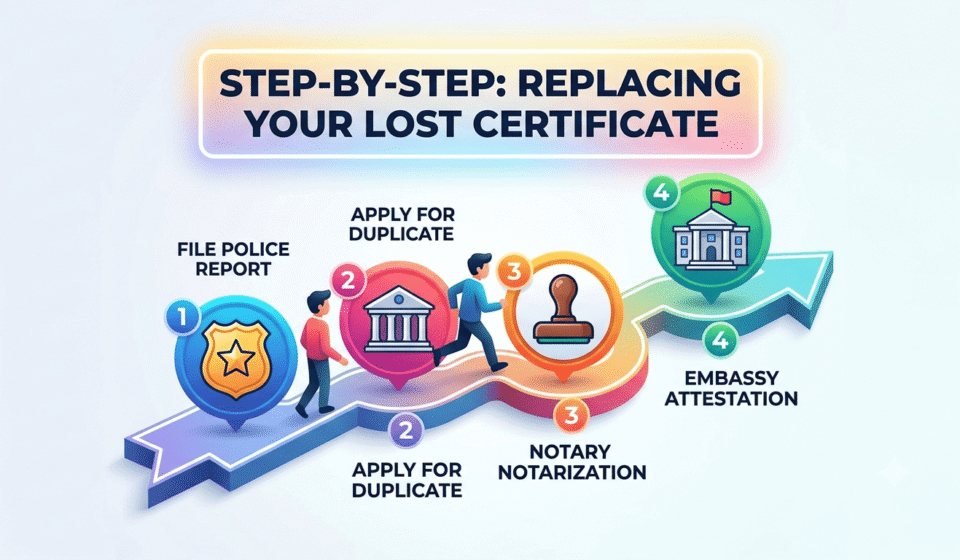
Before you request any duplicate, you need to make the loss official. This step protects you legally and speeds up everything that follows.
Filing a Police Report or Loss Affidavit
Most countries require a police report or a notarized affidavit confirming the certificate is lost, not stolen for misuse. This document becomes your entry ticket to requesting a duplicate.
Why does this matter so much? Because attested certificates carry legal weight, authorities need written proof that the original is unrecoverable before issuing anything new.
What Information Your Report Should Include
A vague report only slows things down. Be specific and thorough from the start.
- Full name and details exactly as they appear on the original certificate
- Approximate date and circumstances of the loss
- Certificate number or reference details, if you remember them
Once this report is filed, keep multiple copies. You’ll need them at nearly every stage ahead.
Getting a Duplicate Certificate from the Issuing Authority
Here’s where the real work begins. Your duplicate certificate has to come from the same body that issued the original.
Approaching Your University, Board, or Institution
Reach out to the registrar’s office or records department directly. Most institutions have a standard duplicate certificate process, though timelines vary widely depending on how old the record is.
Expect to submit these commonly requested items:
- A copy of the police report or affidavit
- Your identification documents
- Old transcripts, admit cards, or any supporting proof of enrollment
- The applicable duplicate certificate fee
How Long Does This Actually Take?
Timelines depend heavily on the institution and country. Some universities issue duplicates within two to three weeks. Others, especially older institutions with paper-based archives, can take a couple of months.
Have you considered building in this waiting period before you finalize travel dates or visa appointments? It genuinely helps to plan around the slowest possible outcome rather than the fastest one.
Restarting the Attestation Process from Scratch
Once you have your duplicate certificate in hand, the attestation clock resets. Yes, this means going through the same layered verification again.
The Standard Sequence You’ll Need to Follow
The order matters here, and skipping a step usually means starting over. Follow this general sequence:
- Notarization of the duplicate certificate by a local notary
- Authentication from the relevant state or regional department
- Verification by your country’s Ministry of Foreign Affairs
- Final attestation or apostille from the destination country’s embassy
Working with Attestation Agencies vs Doing It Yourself
Should you handle this yourself or bring in professional help? It genuinely depends on your comfort level with paperwork and how much time you have.
Doing it independently saves money but demands patience, especially if you’re unfamiliar with the specific government offices involved. Attestation agencies charge a service fee but often cut down the running-around considerably, since they know exactly which counter to visit and when.
Special Situations That Change the Process Slightly
Not every lost certificate scenario plays out the same way. A few situations deserve their own mention.
When the Original Institution No Longer Exists
What happens if the college shut down or merged with another institution years ago? This is more common than you’d think, and it isn’t a dead end.
In these cases, you’ll usually need to approach the regional education board or the government archive that now holds historical records. It takes longer, but a paper trail almost always exists somewhere.
Replacing Certificates Issued in a Foreign Country
If your original certificate was issued abroad, say a degree earned while studying overseas, you’ll need to coordinate with that country’s issuing authority remotely. This often means working through their embassy in your current location or hiring a local representative to handle the institution visit on your behalf.
Smart Habits to Avoid This Mess Next Time
Wouldn’t it be nice to never deal with this stress again? A little preparation goes a long way.
Building a Personal Document Safety Net
Think of this as insurance for your paperwork. It costs almost nothing but saves enormous hassle later.
- Scan and store digital copies of every attested certificate in cloud storage
- Keep a physical photocopy in a separate location from the original
- Share a copy with a trusted family member as a backup
- Maintain a simple spreadsheet listing certificate numbers, issue dates, and locations of originals
Knowing Where Your Documents Physically Live
Do you actually know, right now, where every important certificate is stored? If the answer is “not really,” that’s worth fixing this week rather than during your next emergency.
Designate one secure folder, whether physical or digital, as the single home for these documents. Consistency here is what prevents future panic.
The bottom line
Losing an attested certificate is genuinely frustrating, but it’s rarely a permanent setback. With the right sequence of steps, patience, and a bit of organization, you can rebuild your paperwork and get back on track.
The process takes time, so start early, keep every document copy you generate along the way, and don’t hesitate to ask institutions direct questions about their specific requirements. You’ve got this handled now.
Frequently Asked Questions
Can I use a duplicate certificate for attestation, or must it say “original” somewhere?
Yes, duplicates are accepted for attestation as long as they’re issued directly by the institution and clearly marked as a duplicate or reissued copy with proper authorization.
Will my new attested certificate have a different reference number than the original?
Often yes, since duplicates typically carry a new issue date and sometimes a new serial number, though your core academic or personal details remain exactly the same throughout.
Does losing a certificate abroad complicate the replacement process further?
It can, mainly due to communication delays and needing local representatives. Working through the nearest consulate or a trusted agency usually simplifies coordination significantly.
Is there a time limit for reporting a lost attested certificate?
Most authorities don’t enforce a strict deadline, but reporting promptly strengthens your case and prevents potential misuse of the original document by someone else.
Can attestation agencies guarantee faster processing than doing it myself?
They can often expedite certain steps through established contacts, but government processing times still apply, so guarantees should always be viewed with reasonable caution.