
Dubai cracks down on health ads. New rules ban “Miracle Cures” and Fake Reviews on social media
September 04, 2026 – The Dubai Health Authority has rolled out a strict new rulebook governing how doctors, clinics, hospitals and even influencers can talk about medical treatments online and the list of banned words alone runs into dozens of entries.
If you run a clinic account on Instagram or you’re an influencer who films yourself getting a “glow-up” treatment at a Dubai med spa, the rules have changed.
The Dubai Health Authority (DHA) has published a comprehensive set of standards, titled the Standards for Medical Advertisement Content on Social Media that spells out exactly what licensed doctors, hospitals, clinics and health facilities can and cannot say when marketing themselves online.
The policy covers every major platform like Instagram, Facebook, TikTok, YouTube, Snapchat, WhatsApp and LinkedIn people actually use to search for medical professionals these days.
The move is being read as one of the most detailed attempts yet by a Gulf regulator to police the fast-growing world of “med-fluencing,” where clinics chase views and bookings through flashy before-and-afters, cinematic surgery reels and glowing testimonials.
No More “Miracle,” “Magic,” or “100% Guaranteed”
At the center of the new policy is a blacklist of buzzwords that regulators say have been used to oversell treatments and pressure patients into unrealistic expectations.
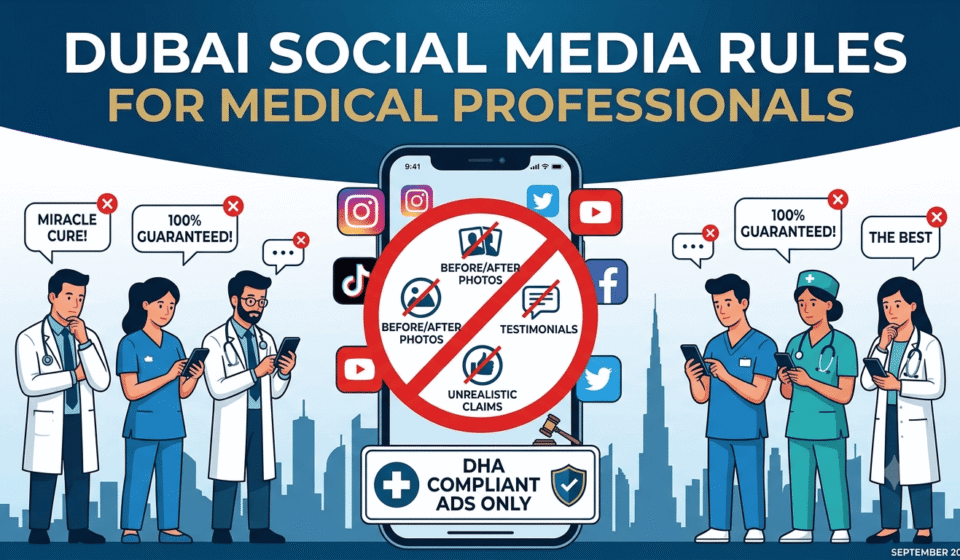
Words and phrases such as “miraculous,” “magic,” “unique,” “the best,” “exclusive,” “safest,” “incomparable,” “unprecedented,” “100 percent,” “absolutely certain,” “assured success,” “has no side effects,” “get your money back,” “famous,” “pioneer,” and “immediate results” are now off-limits in any promotional post.
To put it simply: A clinic can no longer caption a laser hair removal reel with something like “Guaranteed silky skin in one session, zero pain, zero risk!” This single line alone would break at least three separate rules under the new framework, since it combines an absolute guarantee, a safety claim and an unrealistic promise of speed.
Facilities and doctors are also barred from taking swipes at competitors, whether that means bad-mouthing a rival clinic, another physician, or even a government entity in a caption, comment, or video.
Fake Titles Are Out, “Dr.” Is Reserved
The rules also tighten who gets to call themselves what online. Any title used in a bio or a post has to match exactly what’s printed on the person’s DHA license. That rules out popular but informal-sounding titles like “Cosmetic Specialist,” “Aesthetic Consultant,” “Cosmetologist,” “Anti-Ageing Specialist” or “Beauty Expert,” even if the person genuinely works in that field, unless that specific wording appears on their license.
The “Dr” prefix is now similarly locked down. It can only be used by physicians, dentists, or professionals with a genuine PhD, and that PhD certificate has to be attested by the UAE Ministry of Education before it can appear next to someone’s name online. So, under these rules, a nutrition coach with an online doctorate from an unaccredited program would not be allowed to post as “Dr. Sara.”
Influencers Are Now Officially in the DHA’s Sights
Perhaps the most notable expansion is that the standards don’t stop at people with a medical license. Influencers and content creators who promote a clinic’s treatments, showcase their results, or tag a facility are now brought directly under the same regulatory umbrella.
Practically, this means an influencer cannot simply post a sponsored “come get your Hydrafacial with me” video and call it a day. Any post that names or identifies a health facility first needs sign-off from that facility’s medical director.
And the clinic itself remains legally responsible for that content, even when it’s filmed on the influencer’s own phone, from the influencer’s personal account, off the clock.
Consider a common scenario: A beauty influencer visits a Dubai clinic for a filler appointment and posts a reel from her own account, tagging the clinic. Under the old norms, that content might have been treated as personal opinion. Under the new standard, the clinic is responsible for the content as if it were an ad the clinic produced itself, and it needs medical-director approval before going live.
Doctors who practice both in Dubai and abroad face their own version of this rule too. They’re now required to maintain a Dubai-specific account, separate from any international one, that follows these standards in full, even if a post is about a patient they treated overseas.
Consent Is Now Required for Patients’ Photos and Videos
A clinic cannot post a photo, video or written statement from a patient without that patient’s written consent, and if the patient is a minor, a parent has to sign off separately.
Before-and-after photos, a staple of the aesthetics industry’s marketing, come with their own checklist: Both images must be of the same person, taken with the same lens and lighting setup, and they cannot be edited or retouched. Every such post must also carry a disclaimer that results vary from person to person, which is a direct response to the way dramatic transformation photos have historically been used to set unrealistic expectations.
There’s also a hard line drawn around the operating theatre. Filming or live-streaming inside an operating room or procedure room while a patient is under general anaesthesia or undergoing any minor or major surgical procedure is banned outright for marketing purposes.
Accountability Falls on the Medical Director
Under the new framework, each facility’s medical director is now ultimately responsible. That person is now formally responsible for approving every post that mentions the facility, training staff on what is and isn’t allowed, appointing someone specifically to moderate the clinic’s social accounts, and archiving every post so it’s ready if the DHA decides to conduct an audit, which the authority says it can do at any time.
Medical directors are also expected to make sure staff understand what penalties they could face for breaking these rules and to run onboarding and refresher training sessions on acceptable social media conduct on an ongoing basis.
Facilities are further barred from using the DHA’s own logo or name, or the branding of any other government entity, without written permission first. And in an interesting cross-border twist, clinics cannot showcase patients who were treated at their Dubai branch on the facility’s international social media pages.
Scare Tactics, Comparisons and “Cultural Fit” Also Addressed
Beyond the specific word bans, the DHA has laid out broader principles for what counts as unacceptable advertising. Content cannot create unrealistic expectations about outcomes, use scare tactics to pressure someone into a procedure, or take advantage of a patient’s lack of medical knowledge.
A post implying that skipping a treatment will lead to some dire, exaggerated consequence, for example, “wait too long and this wrinkle becomes permanent damage,” would fall foul of the scare tactic clause.
Claiming one doctor’s work is superior to a competitor’s is banned, and so are testimonials that pit different medical specialties against each other. The policy also states that content must not conflict with UAE culture or Islamic values and cannot display intimacy.
Part of a Bigger Push
The DHA frames this circular as part of its broader 2022-2026 strategic roadmap, which has repeatedly emphasized keeping Dubai’s healthcare sector a reliable, trustworthy source of information for both residents and the medical tourists the emirate actively courts.
Officials say the goal is to shield the public from advertising that is unsafe, exaggerated or ethically questionable, at a time when platforms like TikTok and Instagram have become a primary way people research where to get everything from a checkup to a cosmetic procedure.
For clinics and doctors operating in Dubai, the message is fairly direct: The era of loosely regulated, hype-driven medical marketing on social media is over, and both the people behind the camera and the people in front of it will now be held to the same standard.