
Moving abroad, applying for a job overseas, studying at an international university, getting married in another country, or completing an immigration process often requires more than simply carrying your original documents. Government authorities, employers, universities, and other institutions may ask you to prove that your documents are genuine and officially issued.
This is where attestation vs apostille becomes important.
Although both processes are connected with the authentication of documents for international use, they are not the same. An apostille follows a standardized international system created under the Hague Apostille Convention, while attestation generally refers to authentication procedures required by a country or authority.
Choosing the wrong process can result in rejected documents, additional fees, and unnecessary delays. The good news is that understanding the difference between attestation and apostille is relatively straightforward once you know what each process does and when it applies.
Attestation vs Apostille: What Is the Difference?
The simplest distinction is this:
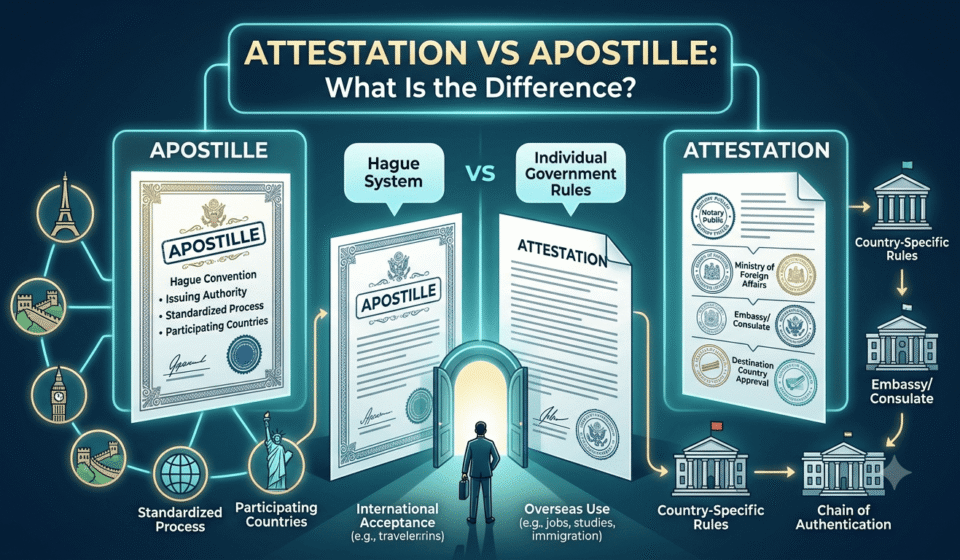
An apostille is a standardized certificate used to authenticate qualifying public documents between countries that participate in the Hague Apostille Convention. Attestation is a broader authentication process used when a destination country requires verification through its prescribed authorities.
The Hague Convention was created to replace traditional legalization procedures with a single apostille certificate issued by a competent authority in the country where the document originated. The Hague Conference on Private International Law says the Convention currently has 130 Contracting Parties.
Attestation, meanwhile, can involve one or several authorities depending on the document, issuing country, and destination country.
|
Factor |
Apostille |
Attestation |
|
Main purpose |
Authenticate qualifying public documents for international use |
Verify signatures, seals, or document authenticity |
|
Legal framework |
Hague Apostille Convention |
Country-specific requirements |
|
Where applicable |
Between participating Hague Convention countries |
Depends on destination-country rules |
|
Process |
Generally standardized |
May involve multiple stages |
|
Issuing authority |
Designated competent authority |
Government departments, foreign ministries, embassies, consulates, or other authorized bodies |
|
Common use |
Immigration, education, employment, legal and personal documents |
Countries requiring traditional legalization or additional authentication |
|
Main advantage |
Simplifies international document authentication |
Meets destination-specific authentication requirements |
The important point is that apostille and attestation are not simply two names for the same service.
What Is an Apostille?
An apostille is an official certificate attached to or placed on a public document to authenticate the origin of that document for use in another country that recognizes the Hague Apostille Convention.
The apostille does not generally confirm that the information inside the document is true. Instead, it authenticates matters such as the signature, the capacity in which the person signing acted, and the identity of the seal or stamp on the document.
The purpose is to make cross-border document use easier.
Under the Hague system, a document that qualifies for an apostille can generally avoid the traditional chain of legalization that would otherwise involve several authorities. The Hague Conference describes this as replacing the often lengthy legalization process with a single Apostille certificate issued by a competent authority where the document originates.
Which Documents Can Receive an Apostille?
The exact rules vary by country, but apostilles commonly apply to public documents such as:
- Birth certificates
- Marriage certificates
- Death certificates
- Court documents
- Notarial documents
- Educational certificates
- Degrees and diplomas
- Certain powers of attorney
- Affidavits and declarations
- Some administrative and commercial documents
For example, India’s Ministry of External Affairs states that India has been a member of the Hague Convention since 2005 and provides apostille services for personal and educational documents, including birth, death and marriage certificates, affidavits, powers of attorney, degrees, diplomas, and school-level certificates.
However, not every document automatically qualifies simply because it is official. The issuing country’s rules and the destination authority’s requirements must still be checked.
What Is Document Attestation?
Document attestation is the process of verifying the authenticity of a document, signature, seal, or certification so that the document can be accepted for an official purpose, often in another country.
Unlike the apostille system, attestation does not describe one universal procedure followed identically around the world.
The required steps can depend on:
- The country where the document was issued
- The country where it will be used
- The type of document
- The authority that issued the document
- The purpose for which it will be used
- Whether the document is personal, educational, legal, or commercial
In some situations, attestation may require authentication by the issuing authority, followed by certification from a foreign ministry and then verification by an embassy or consulate.
This is why two people with similar documents may have different authentication requirements if they intend to use them in different countries.
How Does the Apostille Process Work?
The exact procedure differs by country, but the general process follows a relatively clear structure.
Step 1: Obtain the Correct Document
Start with the document required by the receiving authority.
For example, if an overseas university requests a degree certificate, do not begin with an unrelated educational record simply because it is easier to obtain.
Step 2: Check Whether Certification Is Required First
Some documents may need to be certified, notarized, verified, or authenticated before the competent authority can issue an apostille.
This is particularly important for documents that are not directly issued by a government authority.
Step 3: Submit the Document to the Competent Authority
The apostille must be issued by an authority designated by the country of origin.
In India, for example, the Ministry of External Affairs provides apostille services for eligible documents.
Step 4: Verify the Apostille Requirements
Before sending the document overseas, check whether the receiving organization requires:
- An original document
- A certified copy
- A particular translation
- A recent certificate
- A specific format
- Additional verification
An apostille addresses authentication under the Hague system, but it does not necessarily override other requirements imposed by the organization receiving the document.
How Does the Attestation Process Work?
Attestation can involve more steps because it depends heavily on the destination country’s rules.
A common process may look like this:
Document issuance → local authentication/certification → foreign ministry authentication → embassy or consulate attestation → destination-country verification, if required
Not every document needs every stage.
For example, the UAE Ministry of Foreign Affairs explains that documents issued outside the UAE may need authentication by the foreign ministry of the issuing country and then attestation by a UAE embassy or consulate in the issuing country.
This demonstrates why checking the destination country’s official requirements is essential.
Apostille vs Attestation: Which One Do You Need?
The answer depends primarily on where the document will be used, not simply on what kind of document you have.
Ask these questions before starting:
- Where was the document issued?
- Which country will receive it?
- Are both countries parties to the Hague Apostille Convention?
- Does the receiving authority accept apostilled documents?
- Does the destination country require embassy or consular attestation?
- Does your particular document need prior verification?
- Is a certified translation required?
- Does the receiving organization have its own document requirements?
This approach is much safer than searching for a generic “apostille service” or “document attestation service” and assuming that the first option you find is correct.
Why the Destination Country Matters
One of the most common mistakes is assuming that a document should always be apostilled because apostille is considered a simpler process.
That is not necessarily true.
The Hague Apostille Convention only operates between participating countries and applies to qualifying documents within its scope. Where the Convention does not provide the applicable route, traditional legalization or another authentication process may be required.
Similarly, even when an apostille is available, the organization receiving the document may impose additional requirements.
For example, a university might require a certified translation of an apostilled academic certificate. An immigration authority might request a recently issued civil document. An employer may ask for a specific educational credential rather than every document in an applicant’s academic record.
Authentication and document acceptance are related, but they are not always the same thing.
That distinction can prevent many avoidable mistakes.
Apostille and Attestation for Educational Documents
Educational certificates are among the most frequently authenticated documents for international use.
Students and professionals may need to authenticate:
- Degree certificates
- Diplomas
- Transcripts
- Secondary school certificates
- Professional qualifications
- Training certificates
The requirement may arise when applying for higher education, employment, professional licensing, immigration, or a work visa.
However, educational documents can require additional verification before authentication.
For example, a competent authority may need evidence that the certificate was genuinely issued by the relevant educational institution or authority.
Therefore, before submitting an academic certificate, confirm whether the destination organization requires the original, a verified copy, an apostille, attestation, translation, or a combination of these.
Apostille and Attestation for Personal Documents
Personal documents are another major category.
These can include:
- Birth certificates
- Marriage certificates
- Divorce documents
- Death certificates
- Police clearance certificates
- Affidavits
- Powers of attorney
- Adoption-related documents
Such documents are often needed for immigration, marriage registration, family sponsorship, citizenship matters, inheritance, or legal proceedings.
The requirements can vary significantly.
A marriage certificate intended for use in one country may require an apostille, while another country may require a chain of authentication and embassy verification.
The safest approach is to identify the specific authority that will receive the document and ask what form of authentication it accepts.
Apostille and Attestation for Business Documents
Businesses may also need document authentication when operating internationally.
Examples include:
- Commercial contracts
- Certificates of incorporation
- Trade documents
- Powers of attorney
- Company resolutions
- Board documents
- Commercial registrations
- Certificates of origin
- Business agreements
Commercial documents can be more complicated because the required authentication may depend on how the document was created and signed.
Some jurisdictions distinguish between public documents and private commercial documents, meaning additional notarization or certification may be necessary before authentication.
For companies expanding into another market, confirming the document chain before signing or submitting paperwork can save considerable time.
What Happens If You Use the Wrong Process?
Submitting the wrong authentication can cause more than a minor inconvenience.
Possible consequences include:
- Document rejection
- Delayed visa or immigration applications
- Missed university deadlines
- Additional government fees
- Courier expenses
- Repeated submissions
- Translation costs
- Additional notarization
- Delays in employment or business processes
A particularly frustrating situation occurs when a person completes authentication correctly according to one country’s rules but fails to meet the separate requirements of the organization receiving the document.
This is why the phrase “my document is authenticated” does not necessarily mean “my document will be accepted.”
Common Mistakes to Avoid
1. Assuming Apostille and Attestation Are Interchangeable
They are not. The appropriate route depends on the international framework and destination-country requirements.
2. Checking Only the Country of Origin
Knowing where the document was issued is only half of the answer.
You must also know where the document will be used.
3. Ignoring Document-Specific Rules
A degree certificate may have different requirements from a birth certificate or commercial agreement.
4. Using a Laminated Document When It Is Not Accepted
Some authorities require original documents without lamination. For example, the UAE Ministry of Foreign Affairs states that documents submitted through its courier-based attestation process must not be laminated.
5. Forgetting Translation Requirements
Authentication does not automatically eliminate the need for translation. The receiving authority may require a certified or legally recognized translation.
6. Relying on Old Information
Authentication procedures can change.
For example, the UAE has expanded digital attestation options for certain eligible UAE-issued electronic documents that contain verification features such as QR codes, barcodes, or reference numbers.
Always check current official guidance before submitting documents.
How to Make the Process Easier
A little preparation can make international document authentication much less stressful.
Create a Document Checklist
Write down every document required by the receiving authority.
For each document, record:
- Document name
- Issuing authority
- Country of origin
- Original/copy requirement
- Apostille or attestation requirement
- Translation requirement
- Deadline
- Submission method
Confirm Requirements Before Paying
Do not purchase a service solely because it is advertised as fast or inexpensive.
First establish what authentication your document actually needs.
A service provider can help with logistics, but the receiving authority ultimately determines what it will accept.
Keep Scanned Copies
Create clear digital copies of your documents before submitting originals.
Keep copies of:
- Original documents
- Authentication certificates
- Apostilles
- Receipts
- Application references
- Translations
- Courier records
This can be extremely useful if documents are lost or if another authority asks for evidence later.
Check Names and Dates Carefully
Small discrepancies can cause problems.
Check that names, dates of birth, document numbers, signatures, and other important details are consistent across related documents.
If your passport uses one spelling and your educational certificate uses another, resolve the discrepancy before starting authentication where possible.
Can a Professional Document Service Help?
For straightforward cases, some people can complete authentication themselves using government services.
However, professional assistance can be useful when:
- Multiple documents are involved
- Several countries are part of the process
- Embassy authentication is required
- Documents need prior verification
- You are unfamiliar with the procedure
- You are working against a deadline
- You need courier or submission assistance
- Commercial documents are involved
The important consideration is not simply whether a service promises “fast attestation.”
A reliable provider should be able to explain which authentication route your document requires and why.
Be cautious of providers that guarantee acceptance by an immigration office, university, employer, or foreign government. No intermediary should promise an outcome that is ultimately controlled by another authority.
Is Apostille Better Than Attestation?
Neither is universally “better.”
An apostille can be simpler when the document and destination fall under the Hague Apostille Convention because the system was specifically designed to replace traditional legalization with a single certificate.
Attestation can be the appropriate route where the destination country’s system requires it.
Therefore, the better question is not:
“Which is easier: apostille or attestation?”
Instead ask:
“Which authentication process does the authority receiving my document require?”
That question leads you toward the correct answer.
A Simple Decision Guide
Use this basic framework:
If the document is going from one Hague Convention country to another and qualifies under the Convention:
→ An apostille may be the appropriate authentication.
If the destination country does not use the Hague Apostille system for your situation:
→ You may need legalization or attestation through the required authorities.
If the receiving organization specifically asks for embassy or consular attestation:
→ Follow that requirement even if another authentication option appears available.
If you are unsure:
→ Contact the receiving authority and verify its current requirements before processing the document.
This simple check can prevent significant wasted time.
The Bottom Line!
Understanding attestation vs apostille is essential whenever official documents need to be used internationally. Although both processes help establish document authenticity, they operate under different systems.
An apostille is part of the Hague Convention framework and is designed to simplify the authentication of qualifying public documents between participating countries. Attestation is a broader concept that can involve country-specific authentication, foreign ministry verification, embassy or consular procedures, and other required steps.
The most important practical lesson is simple: do not start with the assumption that your document needs either an apostille or attestation. Start by checking what the receiving authority requires.
Whether you are preparing academic certificates for overseas education, personal documents for immigration, or business paperwork for international operations, confirming the correct process before submission can help you avoid unnecessary costs, delays, and rejected documents.
Frequently Asked Questions
- Is an apostille stronger than attestation?
No. An apostille is not necessarily “stronger” than attestation. They belong to different authentication systems. An apostille is designed for qualifying documents under the Hague Apostille Convention, while attestation follows the requirements of the relevant country and authorities. The correct process is the one accepted by the destination authority.
- Do I need both an apostille and attestation for the same document?
Usually, you should not assume that both are required. An apostille can replace traditional legalization for qualifying documents between Hague Convention countries. However, specific destination-country or institutional requirements may call for additional steps. Always confirm the requirements before obtaining multiple forms of authentication.
- Can I apostille a document myself?
In many countries, applicants can submit eligible documents directly to the designated competent authority, although the exact process varies. Some documents also require prior certification. Before applying, check the official instructions of the country where the document was issued rather than relying only on third-party service providers.
- Does an apostille prove that the information in my document is true?
No. An apostille primarily authenticates the origin of a public document, including relevant signatures, seals, or stamps. It does not generally verify every factual statement contained in the document. The receiving authority may still evaluate the document’s contents and impose separate requirements.
- How do I know whether my document needs apostille or attestation?
Start with the authority that will receive the document. Identify the document type, issuing country, destination country, and intended purpose. Then determine whether the destination accepts an apostille or requires another authentication process. This is more reliable than choosing a service based only on the document’s name.