

Picture this. You have an idea for a product. You are excited. But before you spend a single rupee or dollar building it, you need to know one thing: will people actually buy it?
That question is what market research answers. For years, the process meant expensive surveys, long interviews, and weeks of waiting for results. Most small business owners simply could not afford it.
AI has changed that story completely. Today, anyone with a laptop and an internet connection can research their market like a professional analyst, often within a single afternoon.
If you are a beginner, here is a guide that walks you through exactly how to do market research.
Quick Answer: What Is AI Market Research In Simple Words?
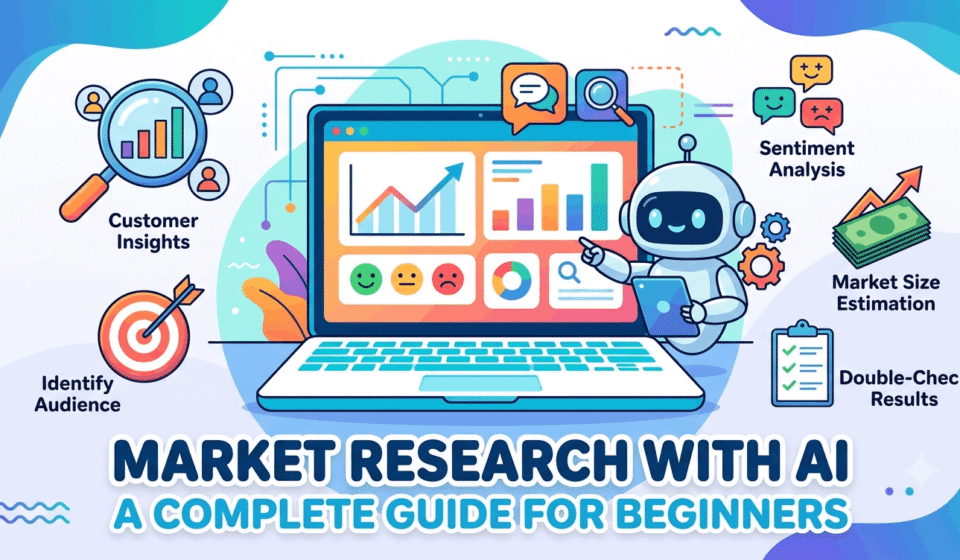
AI market research means using smart tools like ChatGPT, Claude, or Perplexity to study your customers, your competitors, and your industry. These tools read through reviews, articles, and social media posts, then tell you what people actually think.
Instead of spending weeks collecting data, you get useful answers in minutes. The process is simple: decide what you want to know, pick a tool, gather information, let AI find the patterns, and then check the results yourself before making decisions.
That’s the whole idea. Now let’s go deeper.
Why Is Everyone Suddenly Talking About AI Market Research?
Due to changes in technology in 2026 and the fact that it addresses an actual issue, this approach has become increasingly relevant. For many small businesses, traditional research methods were too expensive and time-consuming.
You had to hire agencies, run surveys, and wait weeks for a report that might already be outdated by the time it landed on your desk.
AI changed the game by making research fast, cheap, and available to everyone. Here is what makes it so appealing:
- It saves time: Work that once took weeks now takes hours.
- It saves money: No need for a big research team or expensive agency.
- It works in real time: You see what’s trending today, not last quarter.
- It reads everything: Reviews, tweets, and forums, all scanned in seconds.
- It notices small details: Patterns that a tired human eye might miss.
This is exactly why startups, small shop owners, and even big companies are using AI to understand their market faster than ever before.
How Does AI Actually Understand Customers?
This part confuses a lot of people, so let’s keep it simple.
AI tools use something called natural language processing. In plain words, this just means the AI can read human language, like reviews or comments, and understand the meaning behind it.
It also uses sentiment analysis. This tells you whether people feel happy, frustrated, or neutral about something. So instead of reading five hundred reviews yourself, AI can summarize the mood in seconds.
And there is machine learning too. This means the AI gets better over time as it processes more data. The more information it sees, the sharper its insights become.
Together, these tools help AI act like a research assistant who never gets tired and never misses a detail.
What Are The Steps To Do Market Research With AI?
Let’s break this into simple, easy-to-follow steps. Anyone can do this, even without a research background.
Step 1: What Do You Actually Want To Know?
Before opening any AI tool, pause and think. What exactly are you trying to figure out?
Maybe you want to know why customers stop using your app. Maybe you want to understand your competitor’s pricing. A clear question saves you hours of wasted effort later.
Write this question down. Keep it in front of you as you work.
Step 2: Which AI Tool Fits Your Need?
Different tools are built for different jobs. Some are great at summarizing text. Others are better at pulling live information from the internet.
For example, ChatGPT and Claude are excellent at reading and summarizing large chunks of information. Perplexity AI is better when you need fresh, real-time data from the web.
Choosing the right tool for the right task makes your research much more effective.
Step 3: How Do You Collect The Right Data?
Now comes the gathering part. You need raw information before AI can find patterns in it.
This could be customer reviews, competitor websites, survey responses, or social media comments. AI tools can search the web and pull this information for you quickly, saving you from digging through hundreds of pages yourself.
Step 4: How Does AI Turn Data Into Insights?
This is where things get exciting. Once you have your data, feed it into an AI tool and ask specific questions.
For example, try asking, “What are the top three complaints in these reviews?” The AI will scan everything and give you a clean, organized answer within seconds.
This step alone can save days of manual work.
Step 5: Why Should You Always Double-Check AI’s Answers?
This step matters more than people realize. AI is smart, but it is not always right. It can misunderstand context or even make up information that sounds convincing but is completely false.
So always pause and ask yourself, does this actually make sense? Does it match what you already know about your customers or market? A little human judgment can be very helpful here.
Step 6: What Should You Do With Your Findings?
Research means nothing if you don’t use it. Once you have clear, verified insights, apply them.
Maybe you tweak your product. Maybe you adjust your pricing. Maybe you completely rethink your marketing message. Whatever you learn, put it into action.
Which AI Tools Are Best For Market Research 2026?
Here’s a simple table to help you choose the right tool without wasting time testing everything.
|
AI Tool |
Best Used For |
Why It Stands Out |
|
ChatGPT |
Summarizing data, drafting surveys |
Easy to use, explains things clearly |
|
Perplexity AI |
Live web research |
Pulls fresh, real-time sources |
|
Claude |
Reading long reports and documents |
Handles big chunks of text smoothly |
|
Brandwatch |
Social media listening |
Reads emotions in posts and comments |
|
SurveyMonkey Genius |
Creating surveys |
Suggests smarter survey questions |
|
Semrush |
Competitor tracking |
Watches rivals’ online activity |
|
Google Trends |
Search interest tracking |
Free and simple to understand |
You don’t need to use all of these. Start with one or two that match what you’re trying to learn.
What Types Of Market Research Can AI Actually Help With?
AI is useful in more ways than people expect. Here are some common areas where it really shines.
Tracking competitors
AI watches what other businesses are doing, from new launches to pricing changes.
Reading customer emotions
AI scans reviews and comments to tell you how people truly feel about your brand.
Spotting future trends
By studying past patterns, AI can make smart guesses about what’s coming next.
Speeding up survey analysis
Instead of manually reading hundreds of open-ended answers, AI summarizes them instantly.
Estimating market size
AI can combine multiple data sources to help you understand how big your opportunity really is.
Each of these gives you a piece of the puzzle. Put them together, and you get a much clearer picture of your market.
What Are Some Simple Tips For Better AI Research Results?
A few small habits can make a huge difference in the quality of your results.
- Be specific with your questions. Vague prompts lead to vague answers.
- Never rely on just one source. Always cross-check with something else.
- Treat AI as a helper, not the final decision-maker.
- Refresh your research often, since markets shift quickly.
- Respect customer privacy when handling any personal data.
These small habits keep your research accurate and trustworthy.
What Mistakes Do People Commonly Make With AI Research?
A few mistakes show up again and again, so it helps to know them in advance.
The most common one is blindly trusting AI. Sometimes it sounds confident even when it’s wrong. This is called hallucination, and it happens more often than people expect.
Another mistake is diving in without a clear question. Without direction, AI cannot give you focused, useful answers.
And finally, skipping the human review step is risky. Big decisions should never rest entirely on unverified AI output.
What Can AI Still Not Do Well In Market Research?
AI is powerful, but it’s not magic. Knowing its limits helps you use it wisely.
AI can carry bias if the data it learned from were biased. This can skew how it reads sentiment or predicts trends.
It also struggles with sarcasm and cultural nuance. A joke or an indirect comment might confuse it completely.
And privacy is always a concern. Make sure any tool you use follows proper data protection standards, especially when handling customer information.
What’s Next For AI In Market Research?
AI is only getting smarter. Predictions are becoming sharper, and full research reports can now be generated automatically in minutes.
Businesses that start learning these tools today will likely have a real edge over those who wait too long to adopt them.
Final Thoughts
AI has made market research faster, cheaper, and far more accessible than it ever was before. But the real benefit comes from combining AI’s speed with your own good judgment.
Start small. Pick one clear question. Try one tool. See what you learn. Over time, you’ll build a research process that feels natural, quick, and genuinely useful.
That mix of fast AI insights paired with real human thinking is what actually helps businesses make smarter decisions.
Frequently Asked Questions
What is AI market research?
AI market research is the use of tools like ChatGPT, Claude, and Perplexity to study customers, competitors, and market trends. These tools read reviews, scan the web, and spot patterns in data much faster than a human ever could, turning raw information into clear, usable insights.
What is the best AI tool for market research?
There is no single best tool; it depends on your goal. ChatGPT and Claude are great for summarizing data and spotting themes. Perplexity AI is best for live, real-time research. Brandwatch works well for tracking emotions on social media. Pick the tool that matches the job.
Can AI completely replace human market research?
No, AI cannot fully replace human research. It is excellent at handling large amounts of data quickly, but it still needs a human to check its work, understand context, and make the final call. AI works best as a helper, not a decision-maker.
How accurate is AI market research?
AI market research accuracy depends heavily on the quality of the data used. It can be very accurate at spotting patterns and predicting trends. However, it can also make mistakes if the data is biased or outdated, so results should always be double-checked.
Is AI market research expensive?
No, AI market research is generally affordable and often cheaper than traditional methods. Many AI tools offer free or low-cost plans, which makes them a great option for small businesses, startups, and anyone working with a tight budget.
How do I start doing market research with AI?
Start by picking one clear question you want answered. Then choose an AI tool that fits, like ChatGPT for analysis or Perplexity for live research. Feed it your data, ask your question, and always review the answer yourself before acting on it.
What is sentiment analysis in AI market research?
Sentiment analysis is when AI reads customer reviews, comments, or social media posts to figure out how people feel. It tells you if customers are happy, upset, or confused about a product, without you having to read every single message yourself.
What is the biggest mistake people make with AI market research?
The biggest mistake is trusting AI results without checking them. AI can sometimes sound very confident while giving wrong information, known as hallucination. Always compare AI findings with another source before making an important business decision.
Can small businesses use AI for market research?
Yes, small businesses can absolutely use AI for market research. Many tools are free or low cost, and they do not require a big team or technical skills. A small business can get useful insights in minutes using simple prompts and questions.
What are the limits of using AI for market research?
AI has a few limits worth knowing. It can carry bias from the data it learned on, struggle with sarcasm or cultural context, and occasionally give confident but incorrect answers. It works best when paired with human judgment and a second data source.