
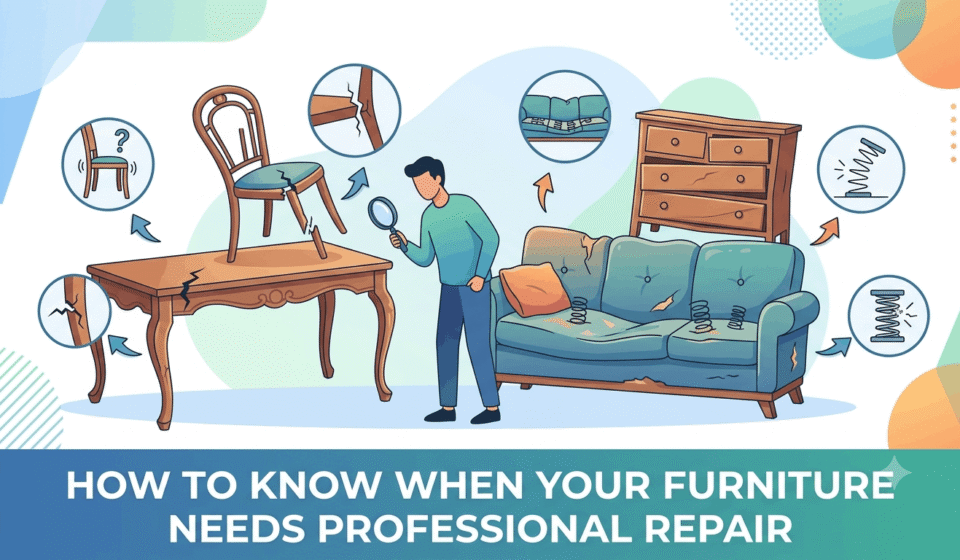

That chair has been wobbling for weeks. You’ve tightened the screws twice. It still rocks the second someone sits down. At what point does “I’ll deal with it later” turn into “this needs a professional”?
Here’s the short version: furniture needs professional repair when the damage affects its structure, stability, or support, not just the surface. A loose joint that keeps coming back, a crack running into a leg, a frame that flexes under normal weight, or springs that no longer bounce back are all warning signs. These aren’t cosmetic problems. They’re signs the piece is weakening where it matters most. Scratches, small scuffs, a sticky drawer slide? Those you can usually handle yourself.
The rest of this guide walks through how to tell the difference, what causes each type of damage, and when picking up the phone actually saves you money instead of costing you more.
The biggest signs your furniture needs professional repair include recurring loose joints, cracks near structural points, sagging or unstable frames, failed springs or webbing, and damage that keeps returning after a DIY fix. Surface scratches, loose hardware, and minor cosmetic problems usually don’t require the same level of repair.
What Causes Furniture to Break Down in the First Place
Wood moves, swells in humid months, and shrinks when the air dries out, and that constant flexing puts stress on every joint in the piece. Add in years of regular use, and adhesives can deteriorate, screws can work loose, and wood around a joint can compress and wear. Upholstery ages differently. Foam breaks down under repeated weight, springs lose tension, and webbing stretches until it can’t hold a seat cushion the way it used to.
None of this means the furniture is poorly made. Even well built pieces wear down eventually. What separates a healthy piece from one that needs help is how far that wear has progressed.
Loose or Wobbly Joints Are a Sign Your Furniture Needs Repair
Push on any joint that shifts when the furniture gets normal use. A dining chair that rocks slightly, a table leg that gives a little when you lean on it. That movement can mean the wood around the joint has worn down, the original glue has failed, or the joint itself has weakened over time.
Tightening the hardware buys you time, not a fix. If the joint loosens again within a few weeks, the wood itself has likely lost its grip, and no amount of retightening changes that. A specialist can disassemble the joint, clean out the old glue, and rebuild the connection so it actually holds.
According to “A comparison of the cyclic durability, ease of disassembly, repair, and reuse of parts of wooden chair frames” by Uysal et al. in Materials & Design, different wooden chair joint designs showed differences in durability and failure behavior under repeated loading. The study also examined how joint failures affected repair and reuse.
Cracks Running Into Structural Points
Not every crack means you need a professional. A hairline split in a flat decorative panel isn’t doing much harm. A crack running through a chair leg or into a table apron is a different story, because that section carries real weight every time someone uses the piece. Cracks that reach a joint, leg, frame, or other load-bearing area deserve a closer look before you keep using the furniture.
Humidity swings can cause these cracks to widen over time. A small split you notice during a dry period can become more noticeable when humidity changes later in the year. If a crack sits anywhere near a joint or a weight-bearing point, get it looked at before it spreads further.
A Frame That Sags or Flexes
Run your hand along the frame and notice where it gives. A sofa that dips in the middle or a bed frame that shifts when you sit on the edge points to a broken or weakened structural component somewhere underneath.
Frame damage rarely stays contained to one spot. The frame distributes weight across the joints and supports around it, so a weak point in one area can put extra strain on the rest. Left alone, one bad section can turn into several, especially when the furniture keeps carrying normal weight every day.
Upholstery That Won’t Bounce Back
Press down on a cushion and watch what happens. A cushion that dips and stays flat, without springing back, can mean the springs, foam, or webbing underneath have given out. This is worth checking separately from the fabric itself, because a torn cover and a collapsed support system look similar from a distance but need completely different fixes.
According to “Evaluation of the cyclic fatigue performance of polyurethane foam in different density and category” by Samet Demirel and Busra Ergun Tuna in Polymer Testing, repeated loading changed the firmness, indentation performance, and thickness of polyurethane foam. The degree of change varied by foam density and type.
Drawers and Doors That No Longer Line Up
Open a few drawers and cabinet doors and pay attention to how they close. Sticking, uneven gaps, or doors that no longer sit flush can point to a shifted frame, wood movement, or worn hardware, especially when the problem shows up on more than one drawer in the same piece. Wood movement from humidity causes this gradually, which is why it tends to show up years after the furniture was new rather than right away.
How to Actually Assess the Damage
A quick walkthrough helps separate a cosmetic issue from a structural one before you decide what to do next.
Start With The Frame
Check every joint for movement, look for cracks, and note anything that feels loose under pressure. If the movement comes from the frame or a load-bearing joint, you’re probably dealing with more than a simple hardware fix.
Test It Under Normal Use
Test it under normal use, but don’t force anything that already feels unstable. Sit in the chair or sofa carefully. Lean on the table the way you normally would. A problem that stays hidden during a visual check can show up the moment normal weight gets applied.
Check Upholstery Support On Its Own
Press the cushions and seating areas separately from checking the fabric. This keeps you from mistaking a torn cover for a collapsed spring system, or the other way around.
Look At The Hardware
Hinges, drawer slides, and other moving parts wear out faster than the wood around them. Sometimes what looks like a big structural problem turns out to be a worn or damaged hardware component.
Weigh The Cost Against The Piece’s Value
Factor in the material quality, how much you’d miss the piece, and what a comparable replacement would run you. That comparison usually makes the decision for you.
What You Can Reasonably Fix Yourself
Plenty of furniture problems don’t need a specialist. Tightening a loose screw, filling a small gap with wood glue, touching up a scratch with a color-matched marker, or swapping out a worn drawer pull can usually do the job. These fixes take basic tools and a bit of patience, and most homeowners can knock them out in an afternoon.
They work because they’re addressing something surface level or mechanical, not the wood structure itself. Try that same DIY approach on a structural joint, though, and you can end up with a repair that fails faster than the original damage did. Matching wood grain, choosing the right adhesive for the wood type, and clamping a joint correctly while it sets all take specific know-how that most people simply haven’t picked up.
When It’s Time to Call a Furniture Repair Specialist
Once damage affects safety, structure, or a piece you actually care about, bring in a professional. A chair that keeps loosening no matter how many times you tighten it, a crack running into a joint, a sofa frame that sags. These are the kinds of problems that belong in a specialist’s hands. Antique furniture and well-built solid wood pieces deserve extra care, since a botched DIY attempt can damage the finish, joinery, or value of a piece.
Timing changes the outcome too. Catching a loose joint or small crack early can make the repair simpler than waiting for the surrounding damage to spread further. A specialist can often stabilize a minor issue in one visit. A broken frame or a fully collapsed upholstery system takes longer.
Mistakes That Make the Damage Worse
A few habits tend to turn a small problem into a bigger one.
- Piling extra screws or glue onto a loose joint instead of fixing the worn wood causing the looseness
- Ignoring a small crack because it looks minor, letting humidity swings widen it over months
- Replacing torn upholstery fabric without checking the springs or webbing underneath first
- Attempting a structural repair with the wrong adhesive or mismatched wood
- Waiting too long after a first repair fails, giving the surrounding wood more time to weaken
Each shortcut can trade a small saving now for a bigger repair bill down the road.
Cost, Time, and Difficulty by Repair Type
|
Repair Type |
Difficulty Level |
Typical Timeline |
|
Tightening loose hardware |
Low, DIY friendly |
Under an hour |
|
Surface scratch or touch up |
Low to moderate |
A few hours |
|
Loose joint requiring disassembly and regluing |
Moderate, professional recommended for structural issues |
One to several days with drying time |
|
Structural frame repair |
High, professional recommended |
Several days to over a week |
|
Full upholstery rebuild with new springs and foam |
High, professional required |
One to two weeks depending on materials |
Repair times can vary depending on the material, size of the piece, extent of the damage, replacement parts, and the repairer’s workload. The timelines above work as general guides rather than fixed turnaround times.
Repair or Replace: How to Decide
Repair tends to make sense when:
- The frame is still structurally sound overall
- The damage sits in one limited area
- The piece uses solid wood or other quality materials
- You’d genuinely miss it, financially or sentimentally
- Repair costs land well below what a replacement would run
Replacement starts to make more sense when:
- Structural damage shows up in multiple spots across the frame
- Repair costs creep close to the price of buying new
- The material has broken down extensively, think rot or rust
- Several major components all need work at the same time
Solid wood furniture with traditional joinery often gives a specialist more options for repair than furniture made from particleboard or laminate. That doesn’t mean engineered materials can’t be repaired, but the type and extent of damage can limit what a repair specialist can restore.
What to Do From Here
Walk through the frame, the joints, and the upholstery support before deciding anything. Handle surface-level and hardware issues yourself if you have the tools and patience. Call a professional when you spot cracks, structural movement, or collapsed upholstery support. For household maintenance issues outside furniture repair, such as a persistent odor from your washing machine, you can also learn how to remove a bad smell from a washing machine before deciding whether professional help is necessary.
If you’re not sure how serious the furniture damage is, an inspection can help you understand whether repair makes sense before you spend money on a replacement. Catching these signs early can keep the repair simpler and get more years out of furniture worth holding onto.
Frequently Asked Questions
How do I know if my furniture needs repair or replacement?
Repair usually makes sense when the frame stays structurally sound and the damage stays contained to one area. Replacement starts to win out once structural damage spreads across multiple points or the repair bill gets close to what a new piece would cost.
Is it worth repairing old furniture?
Older pieces built with solid wood and traditional joinery can respond well to repair, especially when the underlying structure remains sound. The decision usually comes down to construction quality, condition, how much the piece means to you, and how the repair cost compares with buying new.
Can cracked wood furniture be repaired without replacing the whole piece?
In many cases, yes. A furniture repair specialist can assess the crack and choose an appropriate repair method, as long as the surrounding structure remains sound.
Can loose furniture joints be fixed permanently?
A properly rebuilt joint can restore much of the strength and stability of the original connection, depending on the wood, joinery, and extent of the damage. Extra screws or a squeeze of glue without addressing the worn wood tends to loosen again fast.
What are the biggest signs of structural furniture damage?
Recurring loose joints, cracks that reach legs or other load-bearing areas, sagging frames, and furniture that shifts under normal use can all point to structural damage. If the problem keeps coming back after a basic repair, it’s worth having a furniture repair specialist take a closer look.
How much does professional furniture repair usually cost?
It depends heavily on the type of damage, the material, and how complex the repair is. Tightening a joint costs far less than rebuilding a frame or fully reupholstering a piece, so getting a direct quote after an inspection gives you the clearest picture.
What kind of furniture problems actually need a specialist instead of a general handyman?
Anything involving joint reconstruction, veneer matching, or rebuilding upholstery support calls for someone trained specifically in furniture repair. General handyman skills don’t usually cover this kind of work.
Can damaged upholstery be repaired instead of replacing the whole piece?
Yes. A specialist can rebuild the springs, webbing, and foam underneath, then reupholster with new fabric on top. Whether that costs less than replacement depends on the piece, materials, labor, and condition, but repair can make sense when the frame is still worth saving.